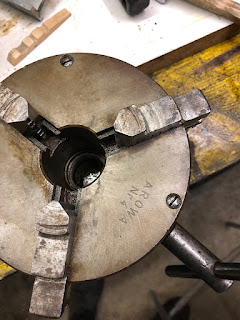
Martha II came with a generous selection of original three-jaw chucks,
made by very, very reputable manufacturers. Unfortunately they all shared one
commonality: They were at least 70 years old and hopelessly worn out.
To my big surprise Din800 M33 is still a pretty common standard on woodworking
lathes. As cutting M33x3.5mm threads by hand is at the best of times "no fun",
I was more than delighted to find out that cheap steel fixture plates are
commonly available, but usually only up to around 125mm, with the odd one
being available in 150mm/6".
So in fact only the center section with the actual thread was really
useful to me (for now) and a cheap 63mm (2 1/2") holesaw made relatively
short work of the mild steel plate.
Trying the same trick on some actual tool-steel finally killed the poor holesaw and left me now other chance than to first drill and then bore the center hole to size.
Bit of TIG-magic later and a hole for a C-spanner later:
The thing with proper tool-steel and the right inserts is, you end up with a really lovely finish.
As the whole "using-a-holesaw-to-drill-the-center-out"-thing really backfired, I decided to do something I had put off for ages. A long while ago, I found a Morse Taper 2 reamer made in the Soviet Republic of Ukraine, still in its original wax coating and wrapper. Based on the writing the outside, I assume it was manufactured in February 1986. So, the brown stuff is almost forty year old wax and not rust. Also it is sharp enough to immediately draw first blood...
The bore cleaned up absolutely beautifully, even though I might have to face the barrel off by a milimetre or two as all the tool sit in there quite a bit deeper than before.
So that's it and I have to admit, even a relatively inexpensive 160mm chuck is a massive improvement over a worn out top-of-the-shelf one from more than 70 years ago.
As I pointed out a year ago,
in my first post on Martha II, whilst bearing a very German name (Matra standing for Marx & Traub), is
actually either "heavily influenced" or a more or less licensed copy of a
LeBlonde Regal 10inch/12inch. So why would such a reputable German manufacturer choose a US design, which
has a strong emphasis on cutting all sorts of imperial threads? The answer
lies in the very first customer. The newly founded German Bundeswehr was well
equipped with a plethora of US-made tanks, which quite obviously, were
equipped with pretty every imaginable thread, but metric. As they also were
rather worn, mobile tank repair units were formed and these were equipped with
exactly these Matra MDR2A lathes.
To make these lathes substantially more useful for use in a metric country,
one of the oldest engineering tricks in the book was employed: slap on a 127
tooth wheel and see how you can turn that 8TPI leadscrew into something that
can at least produce some vaguely useful metric threads. Unfortunately going
down the metric route means that the Norton-box on the front can't be used.
Still, in the end a very useful spread from 0.5mm to 7.5mm thread pitches can
be created. (Special honorable mentions for 0.50, 0.75, 1.00, 1.25, 1.50, 1.75
and 2.0 pitches spanning pretty much everything one can find on regular and
fine thread pitch metric bolts in typical machinery applications.) With that
incentive in mind, I set out to make the metric feeds work again.
A quick rummage through the boxes of small bits (and some large bits),
revealed that the axles for the metric gear scissor were absent, one of the
stub-axles on the tumbler reverse lacked a means of retention and the plunger
of the selector was broken as well and a few small bits like missing shaft
keys and the like.
I started with the shaft keys, because I had to start somewhere anyway, it was
Sunday and I had some stock in the form of a bit of angle iron
available.
In reality it would have been a pretty standard 5x4x25mm shaft key, as is
available form any bearing store, which I suspect was part of making this
machine somewhat metric, just like the spindle nose which sports a very
typical (for the time) Din800 M33 spindle nose (M33x3.5mm).
As I had no drawings of what the original axles would have looked like, I sort
of had to wing it and design them from scratch, with the only real limitations
being that the slot in the scissor was around 15mm wide and the milled out
groove on the back around 23mm, which made M14 a sort of logical choice. As
all the other gears where held on with M12 nuts that was sort of a given as
well.
One of the things I absolutely wanted was to have a way to lube the gears
internally, so the axle shafts were drilled out and had an oil-groove cut in.
One thing I had sort of missed was that the step in the rear was maybe good
enough to locate and space out the gear on the axle, but it was definitely not
good enough to positively locate it on the scissor. Then again as nothing on
such a lathe is allowed to only serve one purpose, I chose some M16 nuts (the
axle diameter is 17mm). Step one was to part off the M16 nut to the correct
width.
Put it back in the chuck and use that same bit of M16 all-thread to align it
properly and then bore it out to a nice press-fit on the shaft.
Which was quite literally a case of *tap-tap*. (And then tig-weld them in
place, just to be sure.)
Getting the whole lot set up, requires roughly 3.5 hands, but once you figured
out it goes: lower gear on the scissor, top gear-set on the scissor and then
tighten the scissor once it is engaged, it is actually manageable.
Now the geared head on the Matra isn't exactly quiet to start with, but the
video only vaguely gives you an idea of the amount of noise that is generated
by the whole gear train.
When trying to switch the tumbler around and into reverse I realised two
things: The reverse gear only had stayed in place so far because it wanted to
and the locating pin on the plunger was missing.
I decided against fabricating this stub-axle from scratch as it turned out not
to be hardened and the only trick bit in making it work was how to hold it in
the chuck to drill and tap it for M8.
A bit of M8 allthread loctite'ed into the stub axle and it was good to go
again.
Which left *just* the plunger to get fixed and have everything working again.
Except there was nothing *just* in this process as it took way longer than it
even remotely should have.
After some casual inspection it became apparent that fixing the old plunger
rod was not going to happen, so I made a fresh one from 10mm silver steel.
Except there were two other ones I made. One on which I ignored the fact that
whilst it was an M8 bolt, it had a 7mm shank (no idea why) and the other one,
also from silver steel, when finishing the cross slide was sucked in and this
elegantly removed the whole thicker section.
The plunger testfitted without a spring.
And lastly two glamour shots - finally with the metal enclosure for the change
gears reinstalled and rather unusual for me, with the chip tray somewhat
cleaned from the majority of the chips.
If you feel like you suffer from a deja vu, well you're not entirely wrong. There used to be a Matra MDR2A in my life before, which thanks to a typo of the seller was called "Marta". As a result it only seemed apt to call the new Matra, Martha the second.
A bit of backstory to those Matra MDR2A lathes. They were heavily influenced by the American Regal LeBlond 10inch lathes, which were found as standard equipment on American WW2 vessels. The Matra with her 240mm swing over bed is a bit smaller. Now these weren't found on ships, but inside tank repair/service trucks. This also explains why a German made lathe can produce a stupidizillion of imperial threads, but only some of the most basic metric thread pitches. (To be fair, those cover about 90 percent of what's out there anyway.) With the step-by-step replacement of the WW2-era American M41 and M47 tanks, the tank-repair trucks also started to become obsolete and by the early 1960ies the German army retired these lathes and sold them off. There is also a civilian version of this lathe, but it doesn't carry the motor on top, but in a more conventional position behind the headstock and thus the casting is notably different.
So what I did is exactly what I tell everyone not to do. I bought a lathe sight unseen and asked a mate to pick it up and deliver it to me. (Luckily said friendly fella, who goes by the name of Torsten, also bought my old Rhino/Coronet and after about a week or two of arranging everything and a very friendly seller, everything worked about as smooth as one could hope for in a deal like this.)
As should be rather evident by the picture above, the lathe came without a suitable cabinet. For a plethora of reasons I chose the approach more akin to a certain Swedish furniture house.
In this picture the reinforcement bar was still missing, because I had to build the cabinet, whilst the lathe was still about 400km away from my workshop.
There's no pictures of the lathe being put up on the stand as that involved three people and a bit of swearing and as a result there was a distinct shortage of spare hands to take photos. Due to the nasty surprise with my last Matra, I checked the spindle nose and it is in pristine condition.
The following morning a slightly more in-depth assessment of the situation was undertaken. Just as the seller told me, it was used for woodwork the last few years. Overall the condition wasn't bad, but very dry. A bit of scotchbrite quickly dealt with the surface rust and a plenty bit of oil made sure it wouldn't come back quickly.
Especially the Norton box needed a lot of penetrating oil and then some regular engine oil to become movable again. Still not entirely sure, whether it wouldn't be a smart move to take the box off and clean it in some diesel.
Speaking of which, the lathe came with two lovely vintage Arowa chucks, a #3 and a #4. Unfortunately a mix of rust and wood-dust locked them up tight. A few days in diesel made them loose enough, so at least the jaws could be removed and the ways derusted and polished with a brass brush.
You can just about make out the amount of rust and crud stuck in those ways and this picture was taken after the first cleaning...
Now a lathe is not really much good without a motor. I chose a 2.2kW single-phase motor running at 2800rpm, mainly because I had two of them and I thought it would not give me much trouble... In comparison to the original switches backplate, this 3mm steel plate is almost flimsy, with the original being made of a casting with at least 6 or 7mm of thickness. In case you're wondering, why the switch is so much to the right, that's because I will need room for the direction-selector-switch later.
Looking good, eh? Well that electric motor wasn't. No matter how it was wired up, it would always trip the breaker.
Luckily I still had a Soviet-era Polish-made 1.5kW Wefamel single-phase motor sitting on a shelf and just as the paper said: "Made by the proud socialist workers of Poland to the highest standards". Not entirely sure what those standards actually are, but it works and is about twice as heavy as a modern electric motor with the same power rating.
... and as I did all the wiring I made sure that the motor and lathe are actually grounded, you know healthy and safety and all that, because electrocutions really spoil the day.
And there she is... in full glory...
... and running too!
All nice and good, but how well does she do her spinny-turny-thingy?
Any further questions? Because I don't. That is some lovely performance, the surface finish is almost like it's been polished, the swarf that came off was almost perfect and subsequent attempts that the old girl is not in the taking prisoners business.
So what's the plan in the near(-ish) future: First I have to get the thread-cutting gears set up for metric and then fabricate two new backplates for new (not yet bought) chucks. Nothing against those lovely Arowa chucks, but they've had their best days probably somewhere around 50 years ago. Other than that, the cabinet still needs some actual trays to put stuff in currently there's just a few planks resting on the bars to get some of the tooling out of the way. And lastly, the motor has to be rewired (again) for a direction-selector-switch so I don't have to turn the lathe back by hand, when thread cutting. Other than that it will see some more cleaning and an oil-change and mostly simply be used because it is in lovely condition and I see no reason to tear it apart just for curiosity's sake.
Oh and last but not least: Special thanks for Torsten for the logistics and quite literally "the heavy lifting", Raffi for even more lifting and Ralf for putting up with all the hassle that was involved to get the lathe from Germany to Austria without even exchanging a single word face to face.