Well, when you read this, the dirty snowflake CX500 is officially on the road. Lately my dad was able to score a white (god bless the 80ies) Giuliari seat hence the little CX finally being named.
Now in preparation for its roadworthyness-test, the main fuse blew and as it turned out the whole bakelite-holder was well beyond its due-date, so a "holder" for modern blade fuses was improvised (it was Sunday of course and dad wanted to get it inspected on Monday). The other thing I found was that the rear brake-light switch had finally given up and was most likely the reason for slowly draining the battery as it had some sort of weird internal shortage.
Dad's verdict was rather positive: The carbs need some more attention as it's a bit sluggish in the middle and the handling is a bit top-heavy, which in my book is not surprising with those pogo-sticks mimicking real shocks in the back.
Showing posts with label making-stuff-pretty. Show all posts
Saturday, 16 May 2020
Saturday, 11 April 2020
The XS Triple Sidecar - Spring cleanup and brake overhaul
With the sidecar bearing most of the weight of my Winter-time motorcycle commutes, Spring clean is as much about cleaning as it is about taking inventory of the damages that have amassed by the same and subsequently identify areas that need work.
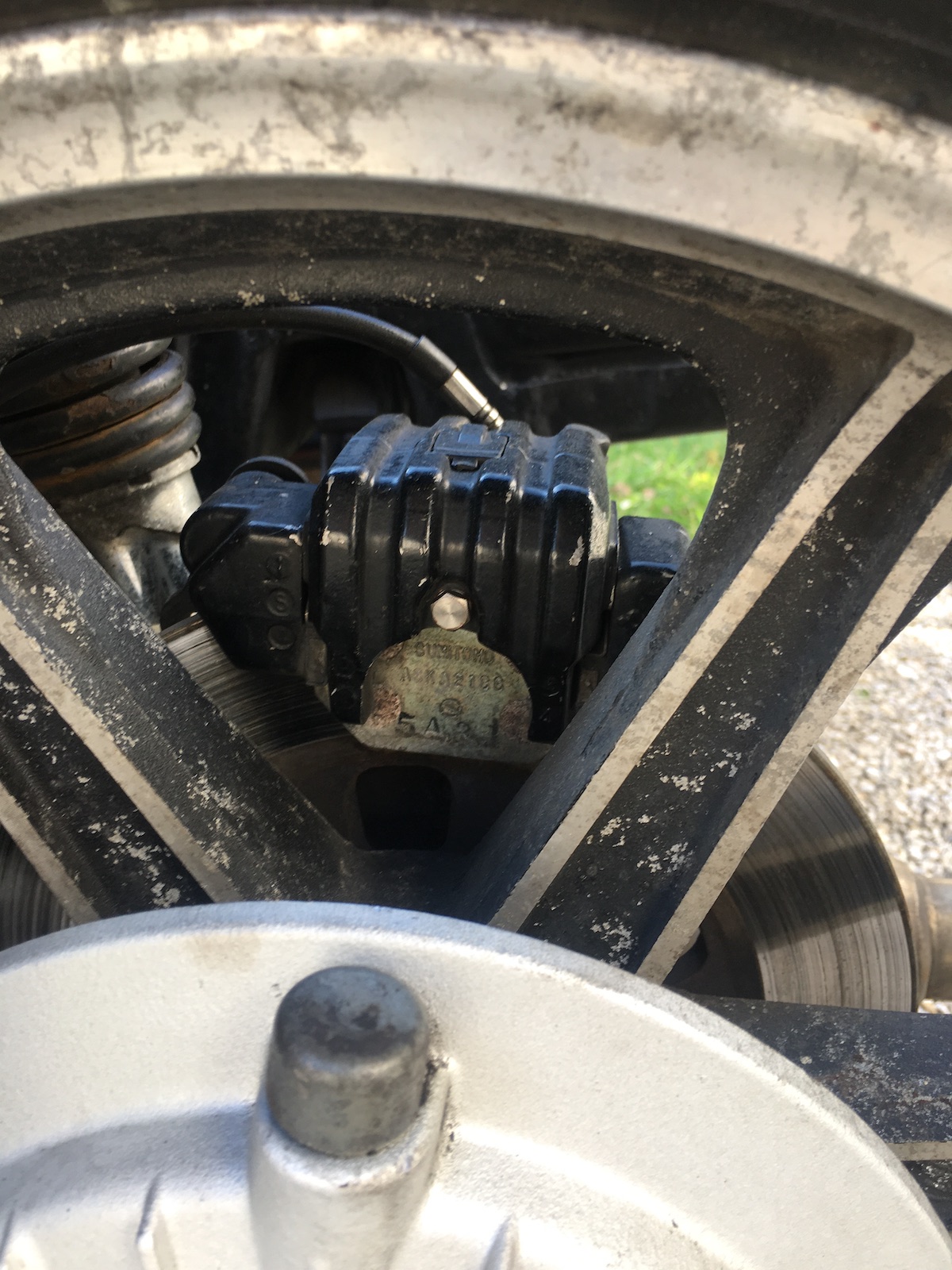
Once again, the protective wax I used has done an admirable job of keeping rust at bay and mostly there have been no real shortcomings to report, aside from the brakes.

When I built the sidecar, I overhauled the brakes with all new seals and stainless steel brake pistons. I was a bit shocked to find out that the dust seals had completely disintegrated and were due for replacement after only two or three seasons.
Plenty of brake-lube (type of petroleum jelly), prevented the worst.
And that's why you want stainless steel brake pistons, even after sitting in the salt they come out immaculate again.
The old seals were thin like paper and about as solid as rotten wood.
In the course of the whole job, I also swapped out the brakepad retainer bolts for stainless items with a hex on the outside. I kept them well lubed with copper-slip, but this allows me to actually use a ratchet to install and remove them.
Note a certain German supplier for SR&XT parts has got them as the original Yamaha bolt is no longer available.
With the stopping side of things sorted out, it was time to focus a bit more on the going faster side of things. As the casual observer might have noticed before, I am a huge proponent of using O2-sensors for fine-tuning carburettors. Now when I built the exhaust for the XS Triple, I did install an O2-bung, but for some unknown reason, I must have slipped an a bit of exhaust tube got in the way plus the thread of these cheap O2-bungs isn't exactly true to the specification. After a bit of die-grinder and tapping action, I was for the very first time able to monitor live, what was actually going on under load.
Yes, that reads as 13.9:1, really more a wonder I haven't burned any holes into my pistons yet. The mix-screws on these carbs are incredibly sensitive, so a 1/4-turn bumped me straight into the high 12s, which instantly meant black skidmarks in the driveway.
You have to give the sidecar credit though, put an old car-battery on the chair, hooked everything up and off you go. (Turns out, the stock reg/rect unit is so noisy, the electronics in the wideband controller were (not very politely) showing me the middle finger.
Why fix this now, when I obviously have the carbs already dialed in somewhat satisfactory? Well, here's a bit of a project outlook for you.
Mikuni VM29SS out of a 1986/1987 GSXR 750 slabbie. They'll need a sh*t-ton of tweaking to fit and I just know I will be cursing myself for using them. But they've got accelerator pumps, are a slightly smaller diameter (29mm vs. 33mm) and I have quite a bit of hands-on-experience with them from installing them on (my) Kawasaki Zeds.
Once again, the protective wax I used has done an admirable job of keeping rust at bay and mostly there have been no real shortcomings to report, aside from the brakes.
When I built the sidecar, I overhauled the brakes with all new seals and stainless steel brake pistons. I was a bit shocked to find out that the dust seals had completely disintegrated and were due for replacement after only two or three seasons.
Plenty of brake-lube (type of petroleum jelly), prevented the worst.
And that's why you want stainless steel brake pistons, even after sitting in the salt they come out immaculate again.
The old seals were thin like paper and about as solid as rotten wood.
In the course of the whole job, I also swapped out the brakepad retainer bolts for stainless items with a hex on the outside. I kept them well lubed with copper-slip, but this allows me to actually use a ratchet to install and remove them.
Note a certain German supplier for SR&XT parts has got them as the original Yamaha bolt is no longer available.
With the stopping side of things sorted out, it was time to focus a bit more on the going faster side of things. As the casual observer might have noticed before, I am a huge proponent of using O2-sensors for fine-tuning carburettors. Now when I built the exhaust for the XS Triple, I did install an O2-bung, but for some unknown reason, I must have slipped an a bit of exhaust tube got in the way plus the thread of these cheap O2-bungs isn't exactly true to the specification. After a bit of die-grinder and tapping action, I was for the very first time able to monitor live, what was actually going on under load.
Yes, that reads as 13.9:1, really more a wonder I haven't burned any holes into my pistons yet. The mix-screws on these carbs are incredibly sensitive, so a 1/4-turn bumped me straight into the high 12s, which instantly meant black skidmarks in the driveway.
You have to give the sidecar credit though, put an old car-battery on the chair, hooked everything up and off you go. (Turns out, the stock reg/rect unit is so noisy, the electronics in the wideband controller were (not very politely) showing me the middle finger.
Why fix this now, when I obviously have the carbs already dialed in somewhat satisfactory? Well, here's a bit of a project outlook for you.
Mikuni VM29SS out of a 1986/1987 GSXR 750 slabbie. They'll need a sh*t-ton of tweaking to fit and I just know I will be cursing myself for using them. But they've got accelerator pumps, are a slightly smaller diameter (29mm vs. 33mm) and I have quite a bit of hands-on-experience with them from installing them on (my) Kawasaki Zeds.
Friday, 14 June 2019
The XS Triple Sidecar - an extensive Spring cleanup
One might be under the impression that in the last 4 months nothing happened to the XS Triple sidecar, but in reality quite the contrary was the case.
First on the list was some electrical problems, which originally started with a burned out alternator and shortly after the reg/rect unit gave in and only worked on first two and then a single phase, which made it weirdly difficult to troubleshoot as the voltage was going up, but it didn't really push out a lot of current.
As I wanted to fix this as quickly as possible, I picked up a very cheap r/r unit, which had a burnt plug. (I also ordered a new one from China, to have a good spare for the future.) After a quick test on the bike it proved to be working, so next was to replace the molten 6-pin connector. Unfortunately this isn't anything unusual, normally coming from a combination of dirty connectors, which are loose on their counterparts.
The thing that I somewhat worried the most about, was the fact that the r/r unit sits on the bottom of the battery tray, which not only is a lot of work to get to, I was absolutely sure nobody had touch those bolts in QUITE a few years.
To my great surprise they came out fairly easily and after a few rust-touch ups everything went together.
And then finally, the bike is charging as it should, pumping out a healthy 14V at idle into a rather empty battery. From here onwards the charging side of things hasn't given me any more headache since Spring (yet).
Next step was to clean off the protective grease and get her ready for the annual road-worthyness inspection. And a dirty girl she was.
(This level of shinyness is most likely unhealthy, at the very least it feels rather odd to me... Still nice to see that the protective grease did its job.)
Still the bike wasn't exactly performing to the fullest. Hanging idle, not starting up very well at times, sometimes backfiring like it was going out of style.
There were two reasons, another coil had rather quietly left the scene and decided to die and the other was the fact that after an unknown mileage the bob-weights of the ignition advancer had worn itself out so far that the ignition advance was wandering around at least 3-4 degrees at idle.
If that ain't a weak spark, I don't know what is.
The solution to the second problem came on the very last models of the XS Triple and was only available in the states in 1983 or 84. A fully electronic ignition with no moving parts that can wear out.
Unfornately the slot on the rotor was seriously mangled, so it had to be welded up and then filed back to the stock size.
Just for comparision that's the first version of the electronic ignition with the mechanical advancer.
Nothing improves reliability like a fresh coat of paint. (And a front mudguard that doesn't rub on the front tyre...)
When swapping tyres for the roadworthyness-inspection, I discovered a slightly odd looking rear shock...
So a "new" set of Konis was procured, but they needed some modifications to prevent this from happening. (Who knew that the correct Konis had a bushing in the right lower shock mount as there's a smaller diameter bolt going through...)
Aside from a new set of needles and subsequent multiple attempts at re-jetting this is pretty much what happened to the old girl. A new set of SE-clocks and upper triples, a new exhaust and some more patching up on the sidecar is still due, but other than that it seems like we're in good shape by now. (Also I may try to officially get the sidecar brake removed from the paper-work as it just an incredibly heavy anchor that is insanely overpowered considering that I mostly ride around alone.)
Monday, 9 July 2018
Dre-XT-Stück - making her mine (part 2)
Right, so the Summer has come, I have owned the Dre-XT-Stück in my name for more than 2 weeks and still haven't ridden it more than from my dad's place to my workshop and at this point it has mostly been a rather large workshop ornament and agreed it does look somewhat cool, but I don't really have room for more than one two-wheeled conversation piece. (And the Turbo does that job really well. 😹)
One of the first things that needed adressing was to make a choke cable to connect a 43F choke lever with a 2KF (i.e. later model) carb.
The next step was to put the forks back to the correct height, as my dad lowered the front by about 30mm and this resulted in the bike weaving and wobbling at high(er) speeds.
(Oh and sorry for the blurry pictures from here onward, seems like my camera has decided that it had enough EMP-exposure...)
That's a whole lot better:
And the last major bit were some decent (as in not bent) ally handlebars. Nothing special, they actually seem to be rather close to stock and won't rust. I didn't swap the handlebar rubbers, even though they have deteriorated rather badly, because they are rusted in solidly and on some second thought a bit of vibration damping might go a long way.
Other stuff that was done was bend the gearshift lever back (the bike probably had been knocked over at some point), clean up some of the wiring, fitted a bash-plate (that's obviously from another model, so I may have to make my own in the long run and make a (hopefully) better fuel tank mount out of two TR1 dampener rubbers.
And some wind-deflectors (genuine 1992-made Acerbis brush guards) added for bad-weather protection.
So what's the verdict: After turning the mix-screw in to one turn, it actually goes pretty well, fuel consumption is at around 5.2 to 5.6 L/100km after the first 300km and she actually manages a top-speed of 130kph, which is quite impressive as this isn't the 600, but only a 500cc version. I will (wholeheartedly) admit, that this is the most sensible motorcycle I have in my stable at the moment, which also is the reason, why it hasn't really "clicked" yet. Don't get me wrong, it's really good at what it does and it will be quite a tad better with some panniers fitted and probably the seat re-padded a bit (it's rather worn in some areas), but truth be told, overtaking a car on a backroad gets a tad exciting and it is in fact a bit buzzy as you have to keep the revs over 4000 rpm to make good progress. Maybe a 600 engine truly is in the cards, as that should in theory give me the highway capabilities I am looking for.
Subscribe to:
Posts (Atom)