In classic bike racing 400cc is a nasty displacement: Too big for the 350cc class and just not beefy enough for the 500cc.
So what's the most logical thing? Go big. Unfortunately the XS400 series started out as an XS360 and was bored out to be more competitive. That said, a 15mm gudgeon pin is definitely lightweight, but not exactly durable and the conrod's small end is a bit flimsy to put it mildly and has a distinct tendency towards deformation.
Luckily a bit of research yielded some very, very interesting results. Now Suzuki's GS500 E is a pretty awesome parts donor, its 74mm diameter pistons being a nice upgrade over the stock 69mm items. With bore and stroke being rather close 52.4mm on the XS and 56.6mm on the GS500 E the pistons are actually pretty close in their overall dimensions.
Now a bit more internet research yielded an interesting result in the shape of FJ1100/1200 and XJR1200/1300 conrods to lower the pistons as the compression height of GS500 pistons is a tad higher than the stock XS400 items.
XS400 cylinders in the back, GS500 in the front.
An otherwise stock XS400 crank and two XJR1200 conrods in the front.
The money shot: The new piston is almost bigger than the bore in the cylinder, with the sleeve removed!
The XJR1200 conrod on the crank.
... and installed.
Showing posts with label XS400. Show all posts
Saturday, 18 June 2016
Wednesday, 15 June 2016
The XS400 RatRacer (part 6) - Finishing touches (For Sale)
Right, there wasn't much left to do in order to get the XS400 RatRacer into presentable shape.
Polished all the shiny bits
Finished off the heat-shields! (They are now welded on properly, and if I may very humbly say so, they look the part, I think.)
Proper brakes - everything new: new pistons, seals, brake-pads, steel-braided brakehose
The workplace: Bare essentials.
You think this bike's cool? Drop me a line and let's have a chat about it. It's gotta go as I have an aircooled RD Racer waiting...
Polished all the shiny bits
Finished off the heat-shields! (They are now welded on properly, and if I may very humbly say so, they look the part, I think.)
Proper brakes - everything new: new pistons, seals, brake-pads, steel-braided brakehose
The workplace: Bare essentials.
You think this bike's cool? Drop me a line and let's have a chat about it. It's gotta go as I have an aircooled RD Racer waiting...
Wednesday, 18 May 2016
XS400 RatRacer - the finishing touches
Finally the XS400 is dialed in and ready to leave the safe harbour of my workshop.
First I timed the ignition and adjusted the points gap. (One of those things you can spend hours on, but truth be told, it's more of a miracle that the bike actually ran at all...)
Synced the carbs (yes, this is the left carb, but the fixed carb is the right one...)
And finally built a wooden subframe to reinforce the seat hump.
The only things left to do: knock up some nicer heat shields and touch up the tank and then the XS is up for grabs, because after all... I am still a two-stroke guy and this is just too heavy, bulky and most importantly four-strokey for me! So if you're interested drop me a line, I do have a number in mind, but it's not a shocking one at all.
First I timed the ignition and adjusted the points gap. (One of those things you can spend hours on, but truth be told, it's more of a miracle that the bike actually ran at all...)
Synced the carbs (yes, this is the left carb, but the fixed carb is the right one...)
And finally built a wooden subframe to reinforce the seat hump.
The only things left to do: knock up some nicer heat shields and touch up the tank and then the XS is up for grabs, because after all... I am still a two-stroke guy and this is just too heavy, bulky and most importantly four-strokey for me! So if you're interested drop me a line, I do have a number in mind, but it's not a shocking one at all.
Saturday, 19 March 2016
XS 400 RatRacer exhaust building (part 5)
With the "Bergrennen St.Martin/Landshaag" coming nearer, it's well about time to get the RatRacer finished. The list has grown sympathetically short by now and one of the last major issues is the state of the exhausts and their mounting.
The silencers started their life as generic "Sito"-brand replacement mufflers. They are reflection dampers and they were indeed very quiet. As such they immediately had to donate their innards to the gods of speed. (Sorry no photos, but trust me, it was messy!) With nothing left to hold on to, I had to TIG-weld the endcaps back on. The mufflers must have been dropped at least once in their life, because they were rather egg shaped on the end cap thus resulting in a not too pleasant to look at weld.
Some flatblack paint hides the worst...
Next: On to the hangers. I chose some 30x2mm stainless flat stock, mostly because I had it in the shop already and it's sturdy enough to take some abuse.
Luckily my XS400 started out as the dreadful XS400 SE-modell (i.e. some custom variant, with a grabrail, high-bars and a smaller rear wheel.) Now the grab-rail was fixed to the same studs that hold the shocks, so there was a convenient place to fix the silencer hangers onto. A bit of ally round stock and presto, we have spacers.
Some trimming left to do, but job's a good un'.
The finished product.
A few more things to do: re-jet the carbs (mains too big), fit a numberplate on the front (not delivered yet) and re-paint the fuel tank.
And then a bit more testriding was due:
Thursday, 10 March 2016
The XS400 RatRacer (part 4) - exhaust building
What goes in must come out somewhere... and as we already dealt with
the what-goes-in-part (i.e. the carbs) it's now time to face the other
end.
There were two main contributing factors for building a high-up exhaust for the XS400. The first one was ground clearance and the second one was that I seemed to have just the right amount of bends left over in stock from previous builds for a high-up system and would have ended up being forced to buy some new tubing, if I wanted to do anything else.
So a quick bit of welding resulted in these two beauties
So far so good. Normally I used some spun rings to center exhaust pipes in the ports. This has the benefit of providing a very proper seal and it centers the pipes nicely in the port, which isn't exactly detrimental to performance. Now I've seen some other (i.e. dodgier) ways of doing by other people and to be fair I wanted to give it a shot and as all of this was just a matter of using up leftovers...
That's a bit of tubing split in half, clamped onto the exhaust tube and then welded to it. Well, it does work - kind of - but it's not the level of sophistication I want in my work, so this is a one off, I tried it and won't ever do it again.
Now with this out of the way, that's what the pipes fitted to the head look like.
An extra bend and we're pretty much sailing...
And truth be told the rest was rather minimal (the final exhaust holders are still missing in the pictures, the angle iron was only meant for holding on the silencers to position the tube for welding...)
(Sorry for the blurry pix, they were taken at a time, when my old camera was about to finally give in...)
There were two main contributing factors for building a high-up exhaust for the XS400. The first one was ground clearance and the second one was that I seemed to have just the right amount of bends left over in stock from previous builds for a high-up system and would have ended up being forced to buy some new tubing, if I wanted to do anything else.
So a quick bit of welding resulted in these two beauties
So far so good. Normally I used some spun rings to center exhaust pipes in the ports. This has the benefit of providing a very proper seal and it centers the pipes nicely in the port, which isn't exactly detrimental to performance. Now I've seen some other (i.e. dodgier) ways of doing by other people and to be fair I wanted to give it a shot and as all of this was just a matter of using up leftovers...
That's a bit of tubing split in half, clamped onto the exhaust tube and then welded to it. Well, it does work - kind of - but it's not the level of sophistication I want in my work, so this is a one off, I tried it and won't ever do it again.
| Just for comparision, that's how I normally do it - looks a lot more proper, I think. |
An extra bend and we're pretty much sailing...
And truth be told the rest was rather minimal (the final exhaust holders are still missing in the pictures, the angle iron was only meant for holding on the silencers to position the tube for welding...)
(Sorry for the blurry pix, they were taken at a time, when my old camera was about to finally give in...)
Tuesday, 8 March 2016
The XS400 RatRacer (part 3) - kickstarter removal
With the kickstart gear not working anyway, I decided to do something, which is quite unusual on a racebike: Get rid of the kickstart assembly, yet retain the electric leg.
Now there's a bit of cleverness behind this madness: Firstly the XS400 is relatively heavy for its class anyway, so shaving off a few kilos might help, but it's never gonna be totally competitive and secondly, in case you drop it or stall it, a quick push of the button gets you going again. Probably saving you more time in such an event than the odd shaved off kilogramm might have won you. Thirdly the kickstarter fouled my rearsets. And lastly with the flatslides I kind of expected to do a lot of rejetting and an electric starter really helps with starting the until you have them dialed in properly.
So here goes: All the stock internal kickstart parts were removed and two bungs were turned up on the lathe, tapped and secured with a central bolt so they'd go nowhere.
Now with the kickstarter removed a quick test of the electric starter revealed... well nothing much. It got warm spun a few times and that was pretty much it. Overhauling electric starters is pretty simple unless someone has used it until the wiring gives in. Usually it means taking it apart, cleaning out all the old carbon buildup and greasing up the shaft's bearing.
As you can see the starter looked pretty much as expected: Pretty grotty, full of old carbon dust and the carbon brushes have left their mark on the collector.
After turning the starter motor's collector smooth again, a small 6Ah battery was sufficient to start the bike.
Now there's a bit of cleverness behind this madness: Firstly the XS400 is relatively heavy for its class anyway, so shaving off a few kilos might help, but it's never gonna be totally competitive and secondly, in case you drop it or stall it, a quick push of the button gets you going again. Probably saving you more time in such an event than the odd shaved off kilogramm might have won you. Thirdly the kickstarter fouled my rearsets. And lastly with the flatslides I kind of expected to do a lot of rejetting and an electric starter really helps with starting the until you have them dialed in properly.
So here goes: All the stock internal kickstart parts were removed and two bungs were turned up on the lathe, tapped and secured with a central bolt so they'd go nowhere.
Now with the kickstarter removed a quick test of the electric starter revealed... well nothing much. It got warm spun a few times and that was pretty much it. Overhauling electric starters is pretty simple unless someone has used it until the wiring gives in. Usually it means taking it apart, cleaning out all the old carbon buildup and greasing up the shaft's bearing.
| Starter taken apart |
| After a quick brush up with some emery, ready to be turned smooth again |
Sunday, 6 March 2016
Overhauling and improving brakes on old Yamahas (The XS400 RatRacer part 2)
With carbs and fueling sorted out, the next step was to beef up the front brake and suspension. A stock XS400 will run a spindly 32mm (which was bent on mine) front end with 270mm brakedisks and a single piston caliper. So I went ahead and swapped the frontend out for a 35mm fork straight out of an early XS650 (but SR500 and various others from the Yamaha family of the same era will work just as well.)
Now you may quite rightfully say: Why a 35mm and not go for something beefier? Two reasons: I had a set of 35mm forks around and lots of vintage racers use them, so there's lots of setup info available to make them perform quite nice.
Now the other thing that is completely underrated is the stock Yamaha single piston caliper. The real reason, why it is often given such bad credit is that the stock brakepumps are too large, they usually are in a bad state of maintainenance and people try to run them with 30 year old rubber brake hose, which inflates like a balloon on a children's birthday party.
The caliper above is pretty much in representative of what you will find on a used Yamaha of the era and exactly the reason, why some people think they have to uprate the brakes madly on these old bikes.
This is what the average brake overhaul kit consists of (actually that's two kits in the picture.) I will not go into detail on how to overhaul the brake, as I don't want to be held responsible, if you c*ck it up. That said, make sure that the seal sits in a perfectly clean groove, clean it out with a rotating brass brush (it has to be a softer material than the aluminium or otherwise you may damage something) and then re-assemble it with brake grease (usually provided with the overhaul kit) or lots of brakefluid and make sure everything works smoothly.
If you've done a proper job, the piston will slide into the caliper only with some gentle pressure applied by your thumb.
Slightly less critical, if you do it wrong, but equally important: Remove the slider bushing on the bottom of the caliper, clean it until it is spotless, lube it up with brake grease and reinstall it. This will stop your pads from wearing unevenly.
Now luckily, these calipers have been fitted to a lot of different models over the years and as such overhaul kits are cheap and plentiful and you can even get pre-made stainless steel brake pistons for them.
One of the other benefits of beefing up the front end was that the XS could now run the bigger 298mm brake disks. Incidentially this is also the diameter of the full floating brake disks on various later Yamaha sport replicas (e.g. FZRs) and the bolt-hole-circle is still the same. Unfortunately the off-set is a bit different, so one has to knock up a spacer to centralize the brake disk in the caliper.
Ironically you already have the perfect spacer if you go with a FZR-brakedisk: The centre-section of your old brake disk has got the holes where they have to be, is the right thickness and only requires liberation from its old outer part. (You could always buy a rear 270mm Yamaha brake disk and take it from there - they are dead cheap as nobody wants them.)
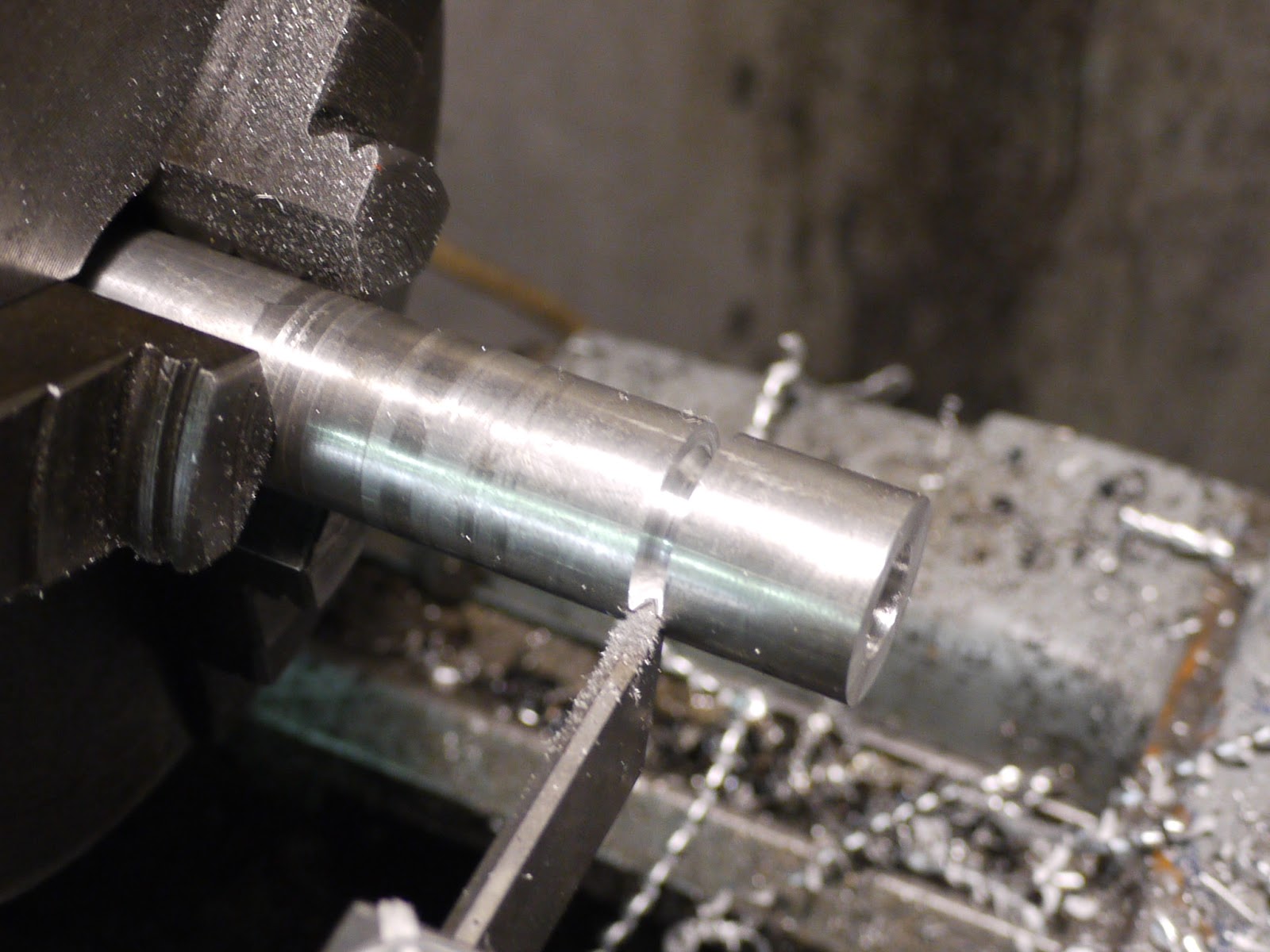
I tidied mine up a bit on the lathe to make it look the part and killed quite a few lathe tips when doing that - this stuff is really, really hard. So it may make sense to go to your local waterjet-cutting place and have one made from aluminium and save yourself a lot of hassle.
Now the rest of the show is pretty simple. Get a set of steel braided brake hose from your preferred manufacturer and get the CORRECTLY SIZED brake pump to go with. For a single Yamaha caliper somewhere between an 11mm pump (very soft, yet very strong) to 1/2" pump (very firm, still heaps better than stock) is the weapon of choice. If you plan on upgrading the brake pump on a Yamaha with twin disks a 14mm pump is generally regarded as the weapon of choice.
Now you may quite rightfully say: Why a 35mm and not go for something beefier? Two reasons: I had a set of 35mm forks around and lots of vintage racers use them, so there's lots of setup info available to make them perform quite nice.
Now the other thing that is completely underrated is the stock Yamaha single piston caliper. The real reason, why it is often given such bad credit is that the stock brakepumps are too large, they usually are in a bad state of maintainenance and people try to run them with 30 year old rubber brake hose, which inflates like a balloon on a children's birthday party.
| Pre-overhaul |
| The brake was still working (-ish) |
This is what the average brake overhaul kit consists of (actually that's two kits in the picture.) I will not go into detail on how to overhaul the brake, as I don't want to be held responsible, if you c*ck it up. That said, make sure that the seal sits in a perfectly clean groove, clean it out with a rotating brass brush (it has to be a softer material than the aluminium or otherwise you may damage something) and then re-assemble it with brake grease (usually provided with the overhaul kit) or lots of brakefluid and make sure everything works smoothly.
| Post-overhaul |
Slightly less critical, if you do it wrong, but equally important: Remove the slider bushing on the bottom of the caliper, clean it until it is spotless, lube it up with brake grease and reinstall it. This will stop your pads from wearing unevenly.
Now luckily, these calipers have been fitted to a lot of different models over the years and as such overhaul kits are cheap and plentiful and you can even get pre-made stainless steel brake pistons for them.
One of the other benefits of beefing up the front end was that the XS could now run the bigger 298mm brake disks. Incidentially this is also the diameter of the full floating brake disks on various later Yamaha sport replicas (e.g. FZRs) and the bolt-hole-circle is still the same. Unfortunately the off-set is a bit different, so one has to knock up a spacer to centralize the brake disk in the caliper.
| Old vs. new |
I tidied mine up a bit on the lathe to make it look the part and killed quite a few lathe tips when doing that - this stuff is really, really hard. So it may make sense to go to your local waterjet-cutting place and have one made from aluminium and save yourself a lot of hassle.
| The finished product |
| No adapters on the caliper required |
Subscribe to:
Posts (Atom)